This guide contains affiliate links to BEWIT.love. If you buy through them, we may earn a commission at no extra cost to you. This never affects what we write.
In this guide
- Give your hands a break before choosing a scent
- What research supports, and what it leaves unanswered
- A flexible five-minute pause
- Decide what belongs in your pause
- Common mistakes that turn a pause into another task
- Safety: skin tolerance and symptoms come first
- Useful questions before you return to work
- If you want a cosmetic oil, buy for that purpose
Give your hands a break before choosing a scent
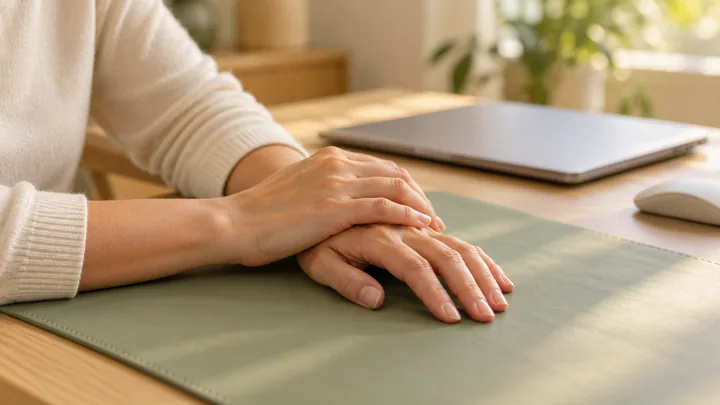
A five-minute pause can be a pleasant way to interrupt a long spell at a keyboard. For an adult with comfortable, uninjured hands, it can include resting the forearms, a little light stroking and time away from the screen. Fragrance is optional. You can make the entire pause without buying anything, and you do not need to press a special point or reproduce an elaborate massage sequence.
The purpose here is ordinary comfort: noticing your hands, loosening your grip on the mouse and giving yourself permission to stop. It is not treatment for pain, numbness or a hand condition. If your hands already hurt, do not try to make them tolerate more pressure. The shopping suggestion at the end concerns adult cosmetic use only; buying an oil is not a response to those symptoms.
Five minutes is a convenient boundary for this suggested routine, not a scientifically established dose. A shorter pause without touch may suit you better. The useful question is whether the break feels comfortable and fits your work, rather than whether you have completed every movement.
What research supports, and what it leaves unanswered
A 2022 meta-analysis combined 22 study samples involving 2,335 people. Micro-breaks produced small improvements in reported vigour and fatigue, but the overall performance effect was not statistically significant. Activities and settings varied; this was not a test of scented hand massage. [1]
A small 2018 trial compared five- and ten-minute practitioner-delivered hand and forearm massage using jojoba oil in 23 healthy female students. Relaxation improved after the shorter session. There was no rest-only control, and lasting effects were not established. It did not test essential oil or desk self-massage. [2]
A 2026 evidence map examined reviews of massage for non-painful adult health conditions. Most conclusions had low or very low certainty, and self-administered techniques were excluded. It cannot validate this desk routine or an added fragrance benefit. A recent publication date does not remove a mismatch between the research and your situation. [3]
Keep three questions separate: does stopping work feel helpful, does gentle touch feel pleasant, and do you enjoy a particular smell? Improvement after combining them cannot tell you which element mattered. A pleasant experience also cannot demonstrate improved immunity, a reset of cellular memory or treatment of inflammation. Those are unsupported claims for this routine, not reasonable interpretations of the studies above.
A flexible five-minute pause
This is an optional comfort sequence, not the protocol used in a clinical trial. The minute markers are organisational prompts, not required exposure times. Keep your breathing ordinary, keep movements easy and stop whenever you wish. There is no target pressure and no sensation you must achieve.
- First minute: step away. Finish the current action, release the mouse and put the phone down. Stand or change position if comfortable. Look away from the screen rather than using the pause to read messages.
- Second minute: choose rest or touch. Support your forearms comfortably. Check that the skin is intact and that nothing is painful. With clean hands, choose no product or a familiar cosmetic intended for skin. If stroking drags unpleasantly, stop instead of rubbing harder.
- Third minute: light contact with one hand. Let the other hand make loose, gentle strokes over the palm or back of the hand. Avoid digging with the thumb, squeezing joints, pulling fingers or forcing the wrist. Keep the hand doing the stroking comfortable too.
- Fourth minute: swap, or simply rest. Offer the same light contact to the other hand if wanted. If your thumbs or forearms are tired, rest both hands instead. You do not need equal repetitions or a particular direction.
- Fifth minute: finish cleanly. Remove slippery residue before touching equipment. Notice whether you feel comfortable, unchanged or worse. Before returning, consider whether your mouse position or work pattern needs attention.
HSE guidance says keyboard breaks should avoid activities with similar arm and hand demands and allow a change of posture. That makes vigorous self-massage a poor default after intensive typing. Choose supported rest or a walk whenever touching one hand makes the other work harder. [4]
Decide what belongs in your pause
| Situation | Practical choice | Boundary |
|---|---|---|
| You want time away from typing | Rest, change position or walk | No product needed |
| You enjoy gentle skin contact | Light stroking, with a familiar skin product if wanted | Stop if either hand works uncomfortably |
| You want a pleasant smell | Consider an already tolerated, ready-made scented cosmetic | Follow its label and respect shared space |
For a first attempt, the simplest option is to keep your usual product and omit extra fragrance. If you already own a suitable, tolerated cosmetic, use that rather than building a collection for the ritual. Our carrier oil guide explains the category distinction. A carrier oil and a concentrated essential oil are not interchangeable.
If you later want a scented option, read the complete product instructions before using it. This article supplies no drop recipe. The essential oil dilution guide provides further background, but a general ratio does not replace the restrictions for a particular oil or finished product. In an office, discuss scent preferences before introducing a fragrance; choosing your own pause does not mean choosing everyone else's air.
Common mistakes that turn a pause into another task
Trying to press out fatigue. It is easy to turn light contact into a determined search for a sore spot. Leave diagnostic interpretations and treatment techniques out of this ritual. There is no need to find a reflex map, count strokes or endure discomfort to make the break worthwhile.
Making the scent compulsory. Disliking an aroma does not mean you chose the wrong emotional remedy. You may simply prefer no fragrance today. Do not keep adding different oils to chase a promised state of calm or interpret a stronger smell as a stronger result.
Replacing the mouse with the phone. Decide beforehand where the phone will stay. Otherwise, the pause can become another round of gripping, scrolling and reading. A small practical boundary, such as leaving the screen facing down, may be more useful to your chosen ritual than an additional bottle.
Overinterpreting a good afternoon. You can jot down whether the pause was pleasant, inconvenient or irritating. That is a preference note, not a personal clinical trial. Workload, sleep, expectations and the chance to stop all vary. There is no need to convert a comfortable moment into a claim about hormones or productivity.
Safety: skin tolerance and symptoms come first
Essential oils can cause irritation and allergic contact dermatitis. Allergy may be delayed, so an immediately comfortable application does not guarantee tolerance. Avoid undiluted essential oils on skin. If a product causes itching, redness or burning, stop using it; a home spot check cannot certify that it is allergy-safe. [5]
Skip rubbing over broken or inflamed skin, a recent injury or unexplained swelling. This routine is for adults; it is not advice for children, pregnancy or animals. If illness, treatment or a previous reaction makes suitability uncertain, ask a qualified clinician before adding massage or a new cosmetic. NCCIH advises against using massage to postpone medical assessment. [8]
Seek medical advice for recurring or worsening pain, tingling or difficulty with everyday activities. Severe pain, loss of feeling, inability to hold objects or a change in hand shape or colour warrant urgent assessment through local services. Do not massage through these symptoms or wait for an oil to help. [6]
Useful questions before you return to work
Must I use lavender or another essential oil?
No. The routine can be a planned pause without fragrance. The relevant hand-massage study used jojoba carrier oil; it does not establish a need for lavender or any other essential oil. Your choice can remain entirely about a smell you enjoy, without assigning it a medical job.
Does a plain oil mean there can be no reaction?
No. A short ingredient list helps you understand the product but does not promise tolerance. Check your own known allergies and the current label. Do not put a new product on already irritated hands just to complete the sequence.
Can I offer a colleague a hand massage?
Only if they freely want it and can stop easily. Ask about touch and any product separately. Do not assume that accepting a break means accepting skin contact or fragrance. An invitation to take a walk or sit quietly is an equally valid way to share the pause.
If you want a cosmetic oil, buy for that purpose
BEWIT Argan Oil lists Argania Spinosa Kernel Oil and directions for application to clean skin and body. It is a cosmetic carrier oil, not a concentrated essential oil or a tested treatment for desk-related symptoms. Check the current bottle instructions before use. [7]
It may fit someone who wants a simple oil for optional light skin contact and already tolerates the ingredient. Keep expectations practical: texture and preference matter, and no purchase is required for the break. If you dislike oily hands or need to handle equipment immediately, choose the product-free version.
Sources and evidence
Evidence checked:
- “Give me a break!” A systematic review and meta-analysis on the efficacy of micro-breaks for increasing well-being and performance PLOS ONE · 2022
- Physiological and Psychological Effects of Short Time Hand Massages:A Randomized Controlled Trial of the Differences in Intervention Duration Japanese Journal of Nursing Art and Science · 2018
- Use of massage therapy for non-painful health conditions: an evidence map of systematic reviews BMC Complementary Medicine and Therapies · 2026
- Should VDU users be given breaks? Health and Safety Executive · n.d.
- Allergic contact dermatitis to essential oils DermNet · 2020
- Pain in the palm of the hand NHS · 2025
- Argan oil BEWIT · n.d.
- Massage Therapy: What You Need To Know National Center for Complementary and Integrative Health · 2019
Never apply undiluted essential oils to skin. Dilute them in a carrier oil first; a suitable strength depends on the oil, the area and how often you use it, so follow the product label and this guide, and patch-test on a small area of skin. Safe Use Guide →
Choose with confidence
Choose a cosmetic, if you want one
For optional light contact on intact adult skin, consider texture, ingredients and your own tolerance. A product-free break is equally valid. This choice is separate from assessing hand pain, numbness or injury.


Be the first to comment