This guide contains affiliate links to BEWIT.love. If you buy through them, we may earn a commission at no extra cost to you. This never affects what we write.
In this guide
- Hemp seed oil is a plant oil, not a promise of CBD
- Three preparations that deserve different labels
- What the research actually examined
- A label checklist you can use in a shop
- The mistakes that create most confusion
- Safety follows the preparation and the route
- Questions worth asking before checkout
- A straightforward cosmetic option, with clear limits
Hemp seed oil is a plant oil, not a promise of CBD
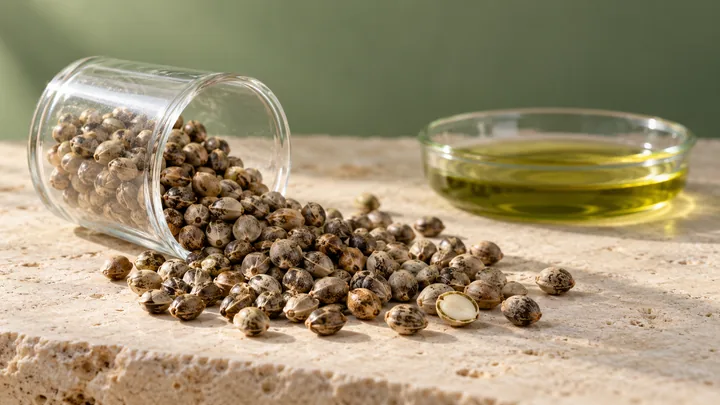
The word “hemp” on a bottle does not tell you whether it contains CBD. Start with the plant part, the preparation and the ingredient list. Oil pressed from hemp seeds, a cannabinoid extract carried in oil, and a distilled aromatic oil are different products. Sharing the botanical name Cannabis sativa does not make their composition, purpose or evidence interchangeable.
The FDA explains that hemp seeds do not naturally contain CBD or THC; traces can reach seed ingredients through contact with other plant parts during harvesting and processing. That distinction rules out two shortcuts: ordinary seed oil is not automatically a meaningful source of CBD, and “seed oil” is not a laboratory guarantee of absolute zero cannabinoids. [1]
This is primarily a guide to reading a purchase accurately. A plain cosmetic oil may be all you want for an adult skincare routine. There is no reason to pay for an implied cannabinoid effect when the seller has not even identified a cannabinoid preparation.
Three preparations that deserve different labels
| Preparation | Useful identifying detail | Do not assume |
|---|---|---|
| Hemp seed oil | Seeds; pressed fatty oil; often Cannabis Sativa Seed Oil | A specified CBD content |
| CBD preparation in oil | CBD or an identified cannabinoid extract, plus its carrier | Equivalence to plain seed oil |
| Hemp essential oil | Distilled aromatic preparation; plant part and process stated | Equivalence to a CBD extract |
Read the whole list rather than one recognisable word. Hemp seed oil could be the carrier in a product that also contains added CBD. In that case, the seed oil tells you about the base, while the separate cannabinoid declaration tells you about the addition. Conversely, a leaf drawing and an earthy product name cannot establish what is inside.
“Hemp extract” also needs clarification. Which part was extracted, by what process, and what does the finished product declare? Do not fill gaps with the most appealing interpretation. A cosmetic ingredient list identifies ingredients; it is not a clinical trial report or a complete batch analysis. For background on the role of the base itself, see our guide to carrier oils.
What the research actually examined
Laboratory composition is not a human benefit
A 2024 laboratory study compared hydrodistillation, ethanol extraction and supercritical carbon dioxide extraction of hemp flowers from one cultivar grown under different field conditions. The resulting cannabinoid and terpene profiles differed substantially. This supports asking about the process, not predicting a skincare or wellbeing benefit. The researchers did not test people, and their flower extracts were not ordinary pressed seed oil. [2]
For label reading, a distilled preparation should not be treated as a standardised CBD product. Nor should “aromatic” be taken as proof that every cannabinoid is absent. Composition requires appropriate analysis; fragrance is not an assay.
A dietary study cannot validate a topical CBD claim
A 2005 randomised, single-blind crossover study compared dietary hempseed oil with olive oil over 20 weeks in adults with atopic dermatitis. It reported changes in fatty-acid profiles and improvements in some self-reported symptoms. This was oral seed oil, not a CBD preparation or a skin application. [3]
A 2023 systematic review describes 20 participants in that trial and notes that improvements from baseline did not translate into significant differences between the intervention and control. Small numbers and limited study conditions constrain the result. It does not establish eczema treatment or justify transferring the findings to a cosmetic bottle. [3]
The practical evidence question is therefore precise: did researchers study this preparation, through this route, in people like the intended users, for the outcome being advertised? A paper mentioning the same plant is only the beginning of that check.
A label checklist you can use in a shop
- Name your intended use. Separate ordinary adult cosmetic care from interest in cannabinoids. If a medical concern prompted the search, discuss it with an appropriate clinician; do not use the shopping checklist as a treatment plan.
- Find the plant part. Look for seed, flower or another clearly identified part. If only “hemp oil” appears, request a fuller description before deciding.
- Read every ingredient. Look for the base oil, any added cannabinoid ingredient, fragrance and other additions. A front label is not a substitute for the complete list.
- Check the declared category and route. Food, cosmetic and aromatic preparations are not permissions to swap between swallowing, skin use and diffusion. Follow the finished product's directions.
- Ask what a CBD number describes. Is it a declared amount of CBD in the finished bottle or merely the mass of an unspecified extract? If the units and substance are unclear, the number is not a useful comparison.
- Match documentation to the bottle. Where cannabinoid content is claimed, ask for a relevant batch report, with identifiable sample, methods and units. An unrelated certificate or a generic quality logo does not resolve the question.
- Check practical ownership details. Read storage instructions, the usable period, batch identification and seller contact details. Choose an amount you can reasonably use according to the label.
You do not need to perform home chemistry. If the seller cannot explain a basic ingredient or intended route, postponing the purchase is a sound outcome. More elaborate branding cannot replace a clear answer. Keep the label and any batch document together so you can recheck what was actually purchased.
The mistakes that create most confusion
Borrowing a claim from another preparation. A finding about purified CBD is not a finding about hemp seed oil. A flower-extraction experiment is not a trial of a massage product. Traditional use may explain interest in a plant, but it cannot establish the effect of today's bottle.
Turning a nutritional description into treatment. A discussion of fatty acids does not establish that an oil “cleans” blood vessels, detoxifies the liver, normalises blood pressure or prevents disease. These broad claims are unsupported for the ordinary seed-oil use discussed here. The selected evidence does not validate them.
Confusing the seed with everything derived from it. A protein powder, a pressed oil and an extract should each be judged by their own label. A claim about whole seeds cannot establish the protein or mineral content of an oil. Check declared nutritional information if nutrition is the purchasing purpose.
Judging strength by colour, scent or packaging. None gives a reliable CBD quantity. “Natural”, “full spectrum” and “premium” cannot replace a clear formulation and relevant documentation. A strong smell does not make the preparation a stronger treatment.
Safety follows the preparation and the route
EFSA's February 2026 update introduced a provisional safe intake level for narrowly specified, highly purified CBD food-supplement formulations. It did not give all hemp products a blanket safety endorsement. EFSA could not establish CBD safety for people under 25, pregnant or breastfeeding people, or those taking medication. [4] This is safety context, not an invitation to self-dose; no intake instructions are provided here.
Cosmetic safety has a separate assessment. In its final 2026 advice, the SCCS considered pure CBD safe up to 0.19% in dermal and oral cosmetic products, separately or combined, on limited available data. It did not assess products exposing the lungs by inhalation. [6] This is not a home formulation recipe, an efficacy finding or approval of an individual bottle.
Do not import those CBD conclusions into a plain cosmetic seed-oil decision, or use a cosmetic label to justify ingestion. For adult skin use, follow the finished product's instructions and avoid experimenting on already inflamed or damaged areas. Stop if a product causes irritation and seek advice if symptoms persist. Ongoing skin disease needs appropriate care rather than a succession of oils.
Keep products away from children and animals. Adult consumer guidance is not a child, pregnancy or veterinary protocol. If an essential oil is being considered separately, consult the essential-oil dilution guide; a carrier oil does not make every aromatic ingredient suitable for everyone.
Questions worth asking before checkout
Does Cannabis Sativa Seed Oil mean CBD?
It identifies the seed oil ingredient. Look for a separate cannabinoid declaration if that is what the seller claims to provide. Do not infer a useful CBD amount from the botanical name alone.
Can hemp seed oil be the base of a CBD product?
Yes, the base and the added ingredient can coexist. Read both declarations and the intended route. The presence of the base does not tell you how much added CBD is present.
Will an analysis report prove that it works?
No. A relevant report can help establish measured composition within the test's scope. Effectiveness for a particular purpose needs suitable human research, and a report cannot supply that evidence.
Must an everyday skin oil contain cannabinoids?
No. Choose according to the cosmetic task, your tolerability and clear directions. Adding a more complicated ingredient category is not itself an improvement in care.
A straightforward cosmetic option, with clear limits
If your goal is an ordinary adult skincare oil rather than a hemp or CBD product, BEWIT Argan Oil is a relevant alternative. Its official page lists Argania Spinosa Kernel Oil and cosmetic directions. [5] It is argan oil, not hemp oil or a CBD substitute. Consider it only for that separate cosmetic purpose; purchasing it is not a response to eczema, pain or another health concern. Compare the current label with your needs before choosing.
Sources and evidence
Evidence checked:
- FDA Regulation of Cannabis and Cannabis-Derived Products, Including Cannabidiol (CBD) U.S. Food and Drug Administration · 2024
- Effect of Hemp Extraction Procedures on Cannabinoid and Terpenoid Composition Plants (MDPI); open full text in PubMed Central · 2024
- Clinical Efficacy of Nutritional Supplements in Atopic Dermatitis: Systematic Review JMIR Dermatology; open full text in PubMed Central · 2023
- Provisional safe level for cannabidiol as a novel food European Food Safety Authority · 2026
- ARGAN OIL BEWIT.LOVE · n.d.
- SCCS - Scientific Advice on Cannabidiol (CBD) (CAS/EC No. 13956-29- 1/ 689-176-3) used in cosmetic products European Commission, Scientific Committee on Consumer Safety · 2026
Essential oils are highly concentrated plant extracts. Follow label instructions, keep them away from children and consult a professional if you are pregnant, nursing or under medical care. Safe Use Guide →
Choose with confidence
Choose a clearly labelled oil for ordinary skincare
If your purpose is everyday adult cosmetic care, compare a simple plant oil with your needs and tolerance. This separate shopping option is not a response to eczema, pain or another health concern.

Be the first to comment