This guide contains affiliate links to BEWIT.love. If you buy through them, we may earn a commission at no extra cost to you. This never affects what we write.
In this guide
- Moringa oil: start with the ingredient, then read the promise
- Read the label as a description, not a scorecard
- What the published evidence actually tested
- A practical decision aid before you buy
- Common mistakes: borrowing benefits from elsewhere
- Safety includes the finished formula and its storage
- Useful questions before the checkout
Moringa oil: start with the ingredient, then read the promise
Choose moringa seed oil by checking what the bottle contains, what it is intended for and whether the seller's evidence concerns that same preparation. A reference to the whole moringa tree is not enough. For ordinary adult cosmetic care, a clearly identified ingredient and realistic expectations are more useful than descriptions such as miracle oil or tree of life.
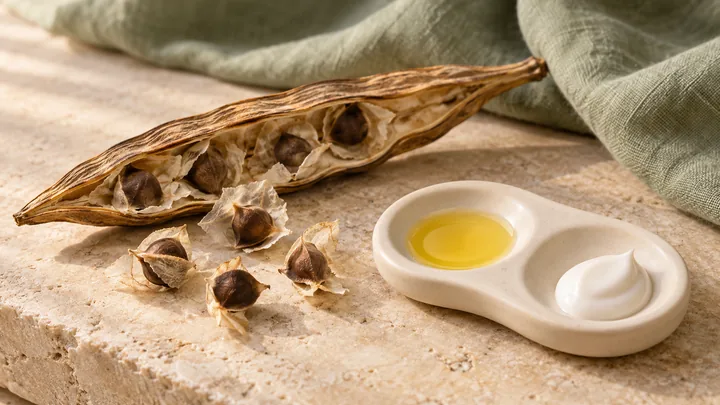
The ingredient name to look for is Moringa Oleifera Seed Oil. COSMILE Europe identifies its source as the seeds and lists skin conditioning and emollient functions: helping soften and smooth skin. That ingredient description is a useful starting point, not proof that a particular bottle treats a skin problem. [1]
The distinction matters because the name moringa travels between very different products. A leaf extract in a cream, seed powder, a pressed seed oil and a fragranced blend should not inherit one another's research results. Before considering benefits, finish this sentence: “This product contains this plant part, in this preparation, for this use.” If the listing does not let you do that, ask for the full label.
Moringa seed oil is a fatty carrier oil, distinct from a distilled aromatic essential oil. Oleic acid is a dominant fatty acid in the material studied. That compositional fact helps describe the oil; it does not establish how a finished cosmetic will perform or confirm every nutrient claim made about the plant. [3]
Read the label as a description, not a scorecard
Start with the complete ingredients list rather than the largest word on the front. Is moringa seed oil the only listed ingredient, one oil among several, or part of a finished cream? Are fragrance ingredients included? None of these formats is automatically the best choice. They simply answer different needs, and they cannot be compared as though they were identical.
A cream containing moringa is a formulated product with other ingredients. A simple oil has a different composition and texture. The research question must follow the actual product. A seller who quotes a cream study beside a bottle of oil should explain the difference, rather than leaving the reader to assume equivalence.
Cold-pressed, natural and premium are descriptions to investigate, not clinical outcomes. Ask what the term tells you about processing, sourcing or certification. Then ask a separate question: what evidence supports the specific result being advertised? A processing description cannot answer whether the finished product will suit your skin.
For a broader introduction to base oils, see our carrier oils guide. Here the narrower task is to stop useful ingredient information being inflated into promises about the whole plant.
What the published evidence actually tested
A small study tested a 25% seed-oil cream on the arms of 32 adults aged 18–65, twice daily for four weeks, against a base cream. Hydration improved; pigmentation and elasticity did not change significantly. This supports a limited formulation-specific finding, not a wrinkle or pigmentation claim for bottled oil. [2]
A separate study exposed cultured human SZ95 sebocytes to moringa oil. It found changes in lipid production and inflammatory signalling. These were cells in a laboratory, not people receiving acne treatment. The findings cannot establish clinical effectiveness or predict whether a consumer will develop spots. [3]
These studies answer different questions. One examined a particular cream on adult skin; the other investigated cell behaviour. Neither gives permission to turn every mention of antioxidant activity into a visible rejuvenation promise. A mechanism may justify further research without establishing a benefit that someone will notice in the mirror.
When assessing a citation, ask whether the participants, route and preparation match the claim. A study of another plant part is not a shortcut. A laboratory comparison is not a head-to-head shopping trial. A positive result for one measurement does not mean every other advertised outcome was tested or improved.
A practical decision aid before you buy
| Check | Useful information | Reason to pause |
|---|---|---|
| Identity | Full ingredient list and intended cosmetic use | Only a plant nickname or broad health story |
| Evidence | Study names the same preparation and outcome | Leaf or cell research presented as proof for bottled oil |
| Practical fit | Clear directions, storage and durability information | Promises replace instructions or basic product details |
- Name your aim. Decide whether you want a simple cosmetic oil or a finished skincare product. Avoid using a shopping decision to solve an unexplained rash or persistent scalp problem.
- Read the entire label. Check all ingredients, warnings and the intended area of use. Save a copy of the listing so you can compare it with the product that arrives.
- Ask for the missing detail. If the retailer cannot explain which moringa ingredient is present, postpone the purchase. A long botanical story does not fill that gap.
- Choose an amount you can realistically use. A larger bottle is not automatically better value if it stays open and unused. Compare packaging and instructions as well as the headline price.
- Keep your existing routine understandable. Introduce one new finished cosmetic at a time, so you can identify whether it is worth keeping.
Imagine two listings. One says only “moringa beauty elixir” and shows an impressive list of plant nutrients. Another shows the full formula and modest cosmetic aims. The second gives you a better basis for a decision, even before you know which texture you prefer. Transparency is something you can assess before purchasing; a promised transformation is not.
If you already have a cosmetic you are happy with, a new botanical name is not itself a reason to change. Ask which information or product feature is missing from your current routine. That answer can narrow the choice and help avoid buying another bottle simply because its description is appealing.
Common mistakes: borrowing benefits from elsewhere
Turning the plant's reputation into the oil's specification. Information about leaves or seed powder does not describe everything in a pressed oil. Ask for evidence about the material actually sold. Do not treat a general nutritional story as an analysis of the bottle.
Reading “human cells” as “human trial”. The wording sounds close, but the practical implications are very different. A cell model lacks the complete conditions of everyday skincare. Calling it proof of a successful treatment skips the clinical question.
Assuming extra essential oils improve the result. The evidence discussed here does not establish that adding fragrance improves moringa's cosmetic performance. A more complicated mixture also makes it harder to identify what you liked or what caused a reaction. If you are learning about aromatic blends, read the separate essential oil dilution guide; this article supplies no mixing recipe.
Buying a treatment promise when you wanted a cosmetic. Softer-feeling skin, fewer wrinkles, altered pigmentation and relief of a scalp disorder are different goals. They need different evidence. You can enjoy a cosmetic texture without upgrading that preference into a medical conclusion.
Safety includes the finished formula and its storage
Follow the product's own directions and assess the complete finished cosmetic before wider use. The American Academy of Dermatology recommends testing new skincare products on a small area first over seven to ten days, stopping and washing off a product that causes a reaction. Such a check does not guarantee future tolerance or replace diagnostic patch testing. [4]
Do not experiment on broken or actively irritated skin, around the eyes or on mucous membranes. Persistent itching, a worsening rash or continuing scalp symptoms deserve professional assessment rather than repeated purchases. This guide concerns ordinary adult cosmetic choices; it does not provide instructions for children, pregnancy or animals. It also provides no ingestion advice or directions for applying raw oil.
Storage belongs in the buying decision. FDA guidance explains that heat, sunlight and air can change cosmetic products, while handling can introduce contamination. Keep the container and applicator clean, follow the manufacturer's storage and durability information, and avoid leaving cosmetics in a hot car. Do not invent a universal shelf life for moringa. [5]
Useful questions before the checkout
Does the name tell me whether this is a leaf extract?
Read the full ingredient name and formula. Moringa Oleifera Seed Oil identifies seed oil; a product described only as moringa needs clarification. Do not assume an extract, an oil and a cream are interchangeable.
Does a short ingredients list guarantee suitability?
No. It can make the formula easier to understand, but it does not establish individual tolerance. Choose according to your needs, the intended use and the complete label, rather than treating simplicity as a safety certificate.
Should I pay more because a seller cites research?
First check whether the research supports the advertised outcome for that preparation. A citation adds value when it helps you understand the evidence and its limits. Its presence alone does not justify a premium.
What if I am open to a different carrier oil?
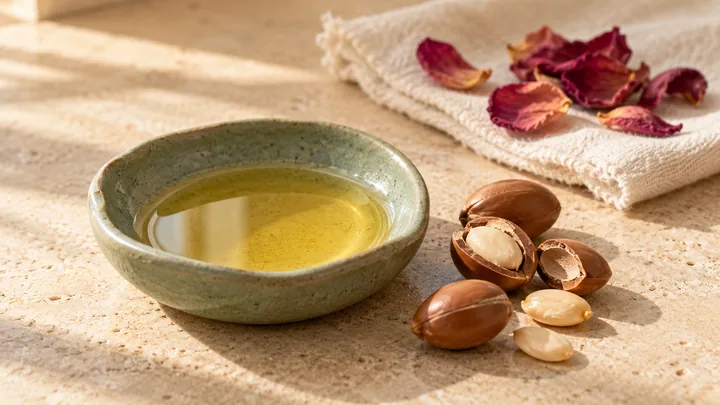
Compare a clearly labelled alternative on its own terms. BEWIT's argan oil lists Argania Spinosa Kernel Oil and a 50 ml option. It is a different botanical oil, not moringa, and moringa research does not establish its effects. Use that label as a comparison point, not a treatment recommendation. [6]
Sources and evidence
Evidence checked:
- MORINGA OLEIFERA SEED OIL COSMILE Europe / Cosmetics Europe · n.d.
- Moringa oleifera Seed Oil Formulation Physical Stability and Chemical Constituents for Enhancing Skin Hydration and Antioxidant Activity Cosmetics (MDPI) · 2021
- Effects of Moringa oleifera Seed Oil on Cultured Human Sebocytes In Vitro and Comparison with Other Oil Types International Journal of Molecular Sciences (MDPI) · 2023
- How to test skin care products American Academy of Dermatology · n.d.
- Shelf Life and Expiration Dating of Cosmetics U.S. Food and Drug Administration · n.d.
- ARGAN OIL BEWIT · n.d.
Essential oils are highly concentrated plant extracts. Follow label instructions, keep them away from children and consult a professional if you are pregnant, nursing or under medical care. Safe Use Guide →
Choose with confidence
An optional carrier oil to compare
If your aim is an ordinary adult cosmetic oil and you are open to another plant, compare the argan label below. This is a shopping option, separate from any skin or scalp health concern; persistent symptoms need professional assessment. It does not reproduce the moringa cream studied.
Be the first to comment