
This guide contains affiliate links to BEWIT.love. If you buy through them, we may earn a commission at no extra cost to you. This never affects what we write.
In this guide
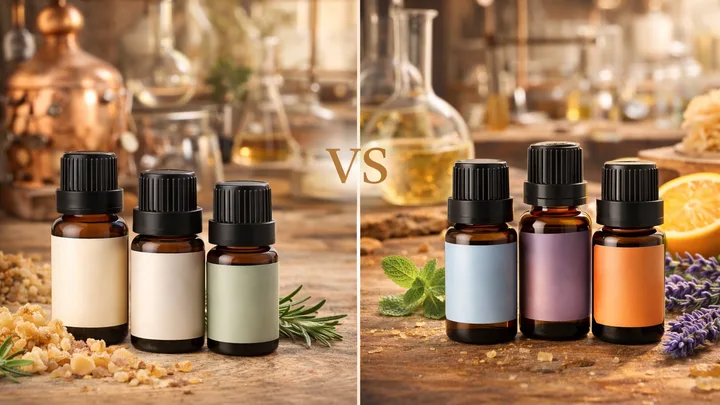
Stand in front of a well-stocked shelf of essential oils and you face a quiet fork in the road: do you buy pure single oils and mix your own, or reach for ready-made blends built for a purpose? Both are legitimate, and most experienced users end up owning both. This guide breaks down essential oil blends vs single oils honestly, so you can spend on the bottles that actually match how you live.

What Is a Single Oil?
A single oil (sometimes called a pure or neat oil) is the distilled or expressed essence of one plant and nothing else. Lavender, peppermint, lemon, frankincense: each bottle holds the aroma and character of a single botanical species. Nothing is added, nothing is combined. What you smell is the plant, faithfully captured.
Because a single oil is one ingredient, it behaves like a raw material. You decide how much to use, what to pair it with, and for which purpose. That freedom is the whole appeal, and also the reason single oils reward a little learning.

What Is a Blend?
A blend is two or more single oils combined in deliberate proportions to serve a defined goal: calm, focus, clean air, an uplifting mood. A good blend is not a random pour; it is a formula in which each oil plays a role, and the whole is designed to be more pleasant and more effective than any single note on its own.
Ready-made blends from a producer like BEWIT are formulated and tested so that every bottle smells and performs the same. You open it, use it, and skip the trial and error. The trade-off is that the recipe is fixed: you get the formulator's vision, not your own.
Single Oils: Pros and Cons
Single oils are the vocabulary of aromatherapy. Learn a handful and you can build almost anything.
Strengths: total control over what goes into every mix; a genuine education in how
each oil smells and behaves; excellent versatility, since one bottle of lemon serves cleaning,
cooking scents, and mood; and a lower cost per use, because you dilute only what you need and one
oil covers many jobs.
Limitations: a learning curve, since you must know what pairs well and at what
ratio; more time at the counter measuring drops; and the risk of an underwhelming result while you
find your footing. If you want an answer in one bottle today, a single oil asks a little more of you.
Start Small
You do not need twenty single oils to begin. Three or four versatile ones (lavender, lemon, peppermint, and a woody oil like frankincense) cover a surprising range. Our guide to the best essential oils for beginners maps out a starter shelf that grows with you.
Blends: Pros and Cons
Blends trade some flexibility for a great deal of convenience, and for many people that is a smart deal.
Strengths: instant convenience with no measuring; expert formulation, since a
trained maker has balanced the notes for you; consistency from bottle to bottle; and a clear purpose,
so a calming blend is ready the moment stress hits. Blends like
Balance and
Miracle deliver a finished experience
the instant you uncap them.
Limitations: a fixed recipe you cannot adjust; usually a higher price per bottle,
since you pay for the formulation work; and less insight into the individual oils, because the
blend hides them inside a single aroma. You gain speed and lose a little control.
Single Oils vs Blends at a Glance
The table below lines up the factors most people actually weigh when they choose.
| Factor | Single Oils | Blends |
|---|---|---|
| Control | Complete: you choose every ingredient and ratio | Fixed: the formula is set by the maker |
| Convenience | Requires mixing and know-how | Ready to use, no measuring |
| Learning value | High: you learn each oil intimately | Lower: notes stay hidden in the mix |
| Versatility | One bottle, many uses | Built for a specific purpose |
| Cost per use | Lower once you build a small collection | Higher per bottle, but no waste on trial mixes |
| Consistency | Depends on your own mixing | Identical every time |
| Best for | Tinkerers, learners, budget-minded users | Busy people who want a reliable result |
Which Should You Start With?
The honest answer for most beginners is: a couple of each. Two or three versatile single oils teach you how aromatherapy actually works and give you room to experiment cheaply. One or two well-chosen blends cover the moments when you want a result without any effort, such as a calming blend for the end of a hard day.
If you love to tinker, lean toward singles first. If your goal is a specific outcome (better sleep, steadier focus, a fresher home) and you would rather not learn ratios, lead with blends. Many people who want calm start with a ready formula before exploring the individual oils behind it; our roundup of essential oils for stress relief shows how both approaches can serve the same goal.
How Blends Are Formulated
Understanding a blend's structure demystifies it and makes your own mixes better. Perfumers and aromatherapists think in three layers of volatility, called notes.
- Top notes are light and fast to evaporate: citrus oils, peppermint, eucalyptus. They form the first impression but fade quickly.
- Middle (heart) notes are the body of the blend: lavender, rosemary, geranium, chamomile. They carry the character.
- Base notes are heavy and slow: frankincense, cedarwood, patchouli, vetiver. They anchor the blend and make the aroma last.
A balanced formula usually combines all three so the scent opens, develops, and lingers. The real magic is synergy: certain oils enhance one another, so the blend feels rounder and more complete than a simple sum of its parts. That is the craft you pay for in a ready-made blend, and the skill you build when you mix your own.
Make Your Own or Buy?
Once you own a few singles, mixing is easy and rewarding. Buying a blend saves time and guarantees consistency; making one lets you tune the aroma to your taste and often costs less per milliliter. Neither is wrong. Try both and see which fits your rhythm.
Simple 3-Oil Starter Blend
For a calming roll-on, combine in a 10 ml bottle:
- 4 drops lavender (heart note)
- 3 drops sweet orange (top note)
- 2 drops frankincense (base note)
Top up with a carrier oil such as jojoba, cap, and roll gently to mix. That single recipe teaches you the top-heart-base structure in one go.
Cost and Shelf Life
On paper a single oil often looks cheaper, but cost per use matters more than the sticker. One versatile single can serve many purposes, spreading its price across months. A blend costs more per bottle because you are paying for formulation and testing, yet you waste nothing on failed experiments.
Shelf life is the quiet factor people forget. Most single oils keep well for one to three years; citrus oils are the exception and fade within a year or two. Blends generally follow the shortest-lived oil inside them. Whichever you choose, store bottles tightly capped in a cool, dark place, and buy sizes you will realistically finish before they turn. Browse ready-made options in the essential oil blends collection when you would rather skip the mixing entirely.
Frequently Asked Questions
Are blends less pure than single oils?
No. A quality blend contains only pure single oils combined together; nothing synthetic is added. The difference is composition, not purity. What matters is the standard the producer holds each oil to.
Can I make any blend from single oils?
Almost. With a modest collection of top, heart, and base oils you can recreate most everyday blends and invent your own. The one thing you cannot easily match is a maker's exact proprietary ratio, but you can usually get very close and to your own preference.
Are blends more expensive?
Per bottle, usually yes, because you pay for the formulation and testing. Per use, the gap narrows, since you waste nothing on trial mixes and every drop is already balanced for its purpose.
Should a complete beginner buy singles or blends first?
Ideally a little of both: two or three versatile singles to learn on, plus one purpose-built blend for instant results. That combination teaches you the craft while still rewarding you from day one.
How long do blends last compared to single oils?
A blend generally keeps only as long as its shortest-lived ingredient, often the citrus notes. Stored cool, dark, and tightly sealed, most blends stay good for one to two years.
Products mentioned in this guide


Discover Premium Essential Oils
Experience the difference of CTEO-certified, European-quality essential oils.
Browse Products
Be the first to comment