This guide contains affiliate links to BEWIT.love. If you buy through them, we may earn a commission at no extra cost to you. This never affects what we write.
In this guide
A temperature sensation is not a healing test
An oil or balm can make skin feel cool, warm or tingly without showing that an injury is healing. The sensation is real; the conclusion about repair does not follow from it. For an adult choosing everyday body care, the useful question is whether the labelled product suits the intended use and remains comfortable. A stronger sensation is not a better result.
Keep three questions separate: what do I feel, what is happening to the skin, and what outcome has research actually measured? A cooling score answers the first question. A measured skin temperature answers part of the second. Neither, by itself, answers whether damaged tissue has recovered. You do not need to provoke a noticeable reaction to justify using a cosmetic.
This guide concerns ordinary adult consumer choices. If you already have an injury, persistent pain or a skin reaction, address that concern independently of shopping. An essential oil purchase should not become the next step in investigating unexplained symptoms.
What human experiments actually tell us
Menthol affects cold sensing through a sensory channel called TRPM8. In a human forearm experiment, topical 10% l-menthol produced both coolness and burning or stinging at resting skin temperature. This was a sensory experiment, not a wound-healing trial, and the concentration is not a home-use recommendation. [1]
A separate experiment applied 5% trans-cinnamaldehyde or its ethanol vehicle to 24 healthy people. It produced itch and redness, with increased local blood flow and skin temperature. Researchers were developing an experimental itch model, not demonstrating repair by cinnamon essential oil. [2]
A 2026 systematic review of topical menthol during exercise included 16 studies and 191 participants. Perceived temperature decreased, while core body temperature did not change. Performance effects varied with circumstances; some subgroup results were sensitive to influential studies. These findings do not establish skin healing or make a retail essential oil equivalent to a studied preparation. [3]
The practical lesson is about choosing the right measurement. A researcher can study perception, blood flow, exercise performance or tissue repair; those are different outcomes. A finding in one column cannot simply be moved into another. Likewise, a laboratory mechanism involving an isolated compound cannot establish the benefit or safety of an entire bottled mixture.
Traditional descriptions such as “warming” or “grounding” may describe a ritual or an association. They are not clinical endpoints. The proposition that an oil warms or cools according to what your body needs remains unsupported by these studies. A list of supposedly warming plants is not a validated way to select treatment.
Read the sensation without diagnosing yourself
Use the following distinctions as a decision aid, not a diagnostic chart. Comfortable sensation, irritation and allergy cannot always be separated by appearance alone. In particular, an initially uneventful application does not settle what will happen later.
| Observation | Reasonable interpretation | Next decision |
|---|---|---|
| Mild, expected coolness | A sensory effect; no proof of repair | Stay within the label; do not intensify it |
| New itch or a rash | A possible adverse reaction | Stop rather than repeat to “check” |
| Pain, swelling or blisters | A warning sign, not a desirable warming effect | Stop and obtain medical help promptly |
Essential oils can cause delayed contact allergy, commonly appearing 24–72 hours after exposure. Undiluted application can lead to sensitisation. A brief home spot check is therefore not a guarantee against allergy and is not the same as clinical patch testing. [4]
Hong Kong’s Department of Health relayed an FDA warning about rare serious burns from topical muscle and joint pain relievers containing menthol, methyl salicylate or capsaicin. This concerns medicinal rubs; it does not estimate the risk for every cosmetic or essential oil. [5]
A label-first checklist before using anything
- Name the purpose. Write “routine care of intact skin” or “I enjoy this scent”, rather than “make it burn so it works”. If your purpose is treating a symptom, a pharmacist or clinician can help choose an appropriate approach.
- Identify the product category. A concentrated essential oil, a plain carrier oil, a finished cosmetic and a medicinal rub are different purchases. Directions for one do not automatically apply to another.
- Read the actual container. Check ingredients, intended application, warnings and storage instructions. If the label does not explain the proposed use, do not supply the missing directions from a social-media recipe.
- Choose simplicity. Consider whether an essential oil is needed at all. A product without an added aromatic blend may fit a routine in which fragrance and tingling are not priorities.
- Set a stopping rule in advance. New discomfort means stopping, not adding another oil, rubbing harder or increasing the concentration. Keep the packaging if you need professional advice.
- Judge the relevant result. For ordinary care, assess whether the product is comfortable and practical. Do not use the intensity of cold or heat as a score for purity, absorption or recovery.
For terminology, see our essential oil dilution guide and guide to carrier oils. Product-specific restrictions take priority over a general chart. These links are background reading, not a prescription for a warming blend.
Before comparing two products, put their instructions side by side. Are you comparing the same category and the same intended use? If one page discusses fragrance and another discusses a medicine, a shared word such as “cooling” does not make them interchangeable. Keep your shopping question narrow enough to answer from the label, rather than trying to solve a health concern through a comparison of sensations.
Common mistakes that turn feedback into a sales claim
“It tingles, so circulation and healing must be improving.” That joins several different claims together without testing the links. Ask whether the research measured the outcome being advertised, in people like the intended users, using the actual preparation and route. If the answer is only “people felt warmth”, the claim should stop there.
“If I feel nothing, I need more.” A cosmetic does not have to announce itself through a dramatic sensation. Do not increase an amount merely to obtain a response. Sensation is not an assay of authenticity: it cannot tell you a bottle's identity, composition or suitability.
“A rash is detoxification.” There is no support in the cited evidence for reading a rash as toxins leaving the body. That story can turn a warning into encouragement to continue. Record what happened in ordinary words, such as itch, pain or changed skin colour, rather than giving it a reassuring explanation.
“Gentle” means safe for everyone. Treat gentle, natural and warming as descriptions to interrogate, not permissions. Neither a botanical name nor a reassuring category replaces the instructions for the finished product. Do not transfer adult advice to children, pregnancy or animals.
Safety: do not amplify the effect
For topical menthol medicines, heat and tight wrapping can increase risks: avoid heating pads or hot-water bottles over the area and follow the specific label. Breathing difficulty or swelling of the face, tongue or throat warrants emergency medical help. [6]
Stop exposure to a suspected irritant. NHS guidance advises rinsing affected skin with warm water and an emollient promptly; persistent, recurrent or severe dermatitis needs medical assessment. [7] Do not keep experimenting on the affected area while trying to decide which explanation fits.
This article does not provide a dilution recipe, advice for swallowing oils or instructions for applying them to wounds, eyes or mucous membranes. Those are separate exposure situations. A consumer comparison cannot resolve an acute reaction. Attend to the reaction first and postpone any product decision.
Useful questions before you buy
Does cooling mean my skin or body temperature fell?
Not necessarily. Perceived coolness, surface temperature and core temperature are distinct measurements. Avoid claiming any one of them from another. The exercise review above is a useful example of why “feels cooler” should be reported in those words.
Could warmth still be pleasant?
Yes, comfort is a legitimate personal preference. It should remain a preference rather than proof of treatment. You can decide that a sensation is unnecessary or unpleasant without needing to explain it through a diagnosis or a supposed deficiency.
Which product is relevant if I simply want routine skin care?
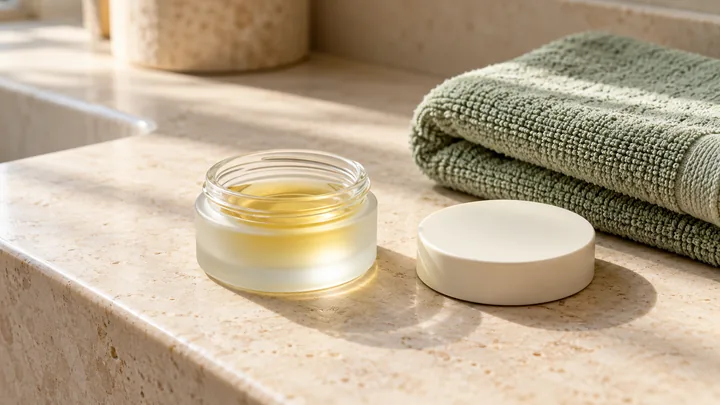
The curated option here is BEWIT Argan oil. Its official page lists Argania Spinosa Kernel Oil and offers a 50 ml option for cosmetic use. [8] It is a carrier oil, not a cooling essential oil. Consider it only for ordinary care of intact adult skin, following its label and your tolerance; it is not an antidote to a reaction or a treatment for injury.
Should I buy an oil to find out why my skin burns?
No. Investigating burning and choosing an optional cosmetic are separate decisions. Keep the product involved and its ingredient list available for a healthcare professional. You can leave the shopping basket empty while getting the concern assessed.
Sources and evidence
Evidence checked:
- Thermal and nociceptive sensations from menthol and their suppression by dynamic contact Behavioural Brain Research; PubMed · 2007
- A human surrogate model of itch utilizing the TRPA1 agonist trans-cinnamaldehyde Acta Dermato-Venereologica; PubMed · 2015
- Acute topical menthol application and exercise performance: A systematic review and meta-analysis of perceptual and physiological responses Journal of Thermal Biology; University of Western Australia repository · 2026
- Allergic contact dermatitis to essential oils DermNet · 2020
- Rare cases of serious burns with the use of over-the-counter topical muscle and joint pain relievers Department of Health, Drug Office, Hong Kong · 2012
- Menthol - Topical MyHealth.Alberta.ca; First Databank · 2025
- Overview - Contact dermatitis NHS · 2023
- ARGAN OIL | BEWIT.LOVE BEWIT · n.d.
Essential oils are highly concentrated plant extracts. Follow label instructions, keep them away from children and consult a professional if you are pregnant, nursing or under medical care. Safe Use Guide →
Choose with confidence
Choose routine care without chasing a stronger sensation
Shopping is separate from investigating burning, rash or injury. Once that concern is addressed, this optional carrier oil may fit ordinary care of intact adult skin. Read the current label and choose by tolerance; buying nothing is also reasonable.

Be the first to comment