
This guide contains affiliate links to BEWIT.love. If you buy through them, we may earn a commission at no extra cost to you. This never affects what we write.
In this guide
Open a bottle of eucalyptus essential oil and you understand instantly why it has become the signature scent of clear, fresh air. Cool, camphoraceous, and sharply green, Eucalyptus globulus is the oil people reach for when the air feels heavy and breathing feels like work. This guide covers the eucalyptus oil benefits worth knowing, exact recipes for congestion season, and how to tell a great bottle from a mediocre one.

The Tree Behind the Oil: Eucalyptus globulus and 1,8-Cineole
Eucalyptus globulus, the Tasmanian blue gum, is a fast-growing evergreen native to Australia that can reach 60–70 metres in height. Its narrow, sickle-shaped adult leaves are packed with oil glands — it takes roughly 50 kg of fresh leaves and twigs to steam-distil about 1 kg of essential oil. Today most of the world's production comes from plantations in China, Portugal, Spain, and Brazil.
Chemically, this oil is remarkably single-minded. Its dominant constituent is 1,8-cineole (also called eucalyptol), which typically makes up 60–85% of a good Eucalyptus globulus oil. It is this molecule that delivers the instantly recognisable cool, penetrating aroma and the sensation of open, easier-feeling breathing when you inhale it. Smaller amounts of alpha-pinene and limonene round out the profile with piney and citrusy facets.
Aroma Profile: What Does Eucalyptus Actually Smell Like?
Eucalyptus globulus sits firmly in the camphoraceous family. Expect:
- Top note: a cold, almost minty rush that hits the nose immediately
- Heart: green, slightly medicinal freshness with a hint of pine
- Dry-down: soft, woody-balsamic trace that fades within an hour
As a scent, it evaporates quickly — eucalyptus is a classic top note. That makes it brilliant for short, intense rituals (a shower, a sauna round) and means that in diffuser blends it benefits from slower partners like cedarwood or frankincense to give the aroma staying power.

Six Practical Ways to Use Eucalyptus Oil
1. The Shower Steam Ritual
The simplest use for eucalyptus for congestion season: place 3 drops on the shower floor, away from the direct stream of water, just before you step in. The hot water vaporises the oil and turns your bathroom into a personal steam room for 5–10 minutes. Breathe slowly through the nose. Do this in the morning — the aroma is energising, not sedating.
2. Winter Diffuser Blends
For a standard ultrasonic diffuser (100 ml of water), try these exact recipes:
- Clear Morning: 3 drops eucalyptus + 2 drops peppermint + 2 drops lemon
- Forest Air: 3 drops eucalyptus + 3 drops pine or fir needle + 1 drop cedarwood
- Winter Comfort: 2 drops eucalyptus + 2 drops rosemary + 2 drops orange + 1 drop clove
Run the diffuser for 30–45 minutes in a ventilated room, then take a break. Eucalyptus is a natural fit for cold-season routines — it appears in several of the blends in our guide to essential oils for the immune season.
3. Chest Massage Blend (2%, Adults Only)
For a warming evening chest and upper-back rub, mix a 2% dilution: 4 drops of eucalyptus in 10 ml (2 teaspoons) of carrier oil such as sweet almond or jojoba. Massage into the chest and upper back with slow strokes, then breathe deeply for a few minutes. If you are new to dilution maths, our essential oil dilution guide breaks down percentages, drop counts, and carrier oil choices in detail.
4. Sauna Bucket
Eucalyptus is a sauna classic across Central Europe. Never drip the oil directly onto hot stones — undiluted oil can flash and burn. Instead, add 5–8 drops to a full sauna bucket (about 3–5 litres of water), stir, and ladle the scented water onto the stones. The burst of cineole-rich steam is invigorating and pairs beautifully with the classic hot–cold contrast routine.
5. Home Office Air Freshness
A stuffy afternoon workspace dulls concentration. Put 1–2 drops on a ceramic aroma stone or a folded tissue next to your monitor — enough for a subtle scent zone of about one metre without overwhelming the room. Alternatively, diffuse the Clear Morning blend above for 20 minutes after lunch as a natural afternoon reset.
6. Sports Bag Deodorizer
Eucalyptus makes a ruthless enemy of gym-bag odour. Add 5 drops to a cotton pad or a wooden clothespin and tuck it into your sports bag or shoe cabinet. Refresh once a week. For trainers, 2 drops on a small piece of paper towel inside each shoe overnight works just as well.
Eucalyptus Through the Seasons
| Season | Use | Recipe |
|---|---|---|
| Winter | Congestion-season diffusing | 3 drops eucalyptus + 2 drops peppermint + 2 drops lemon in a 100 ml diffuser |
| Winter | Evening chest massage (adults) | 4 drops eucalyptus in 10 ml carrier oil (2% dilution) |
| Spring | Deep-clean scent for floors | 5 drops eucalyptus + 5 drops lemon in a bucket of mopping water with a splash of vinegar |
| Summer | Sports bag and shoe deodorizer | 5 drops on a cotton pad, refreshed weekly |
| Autumn | Morning shower steam | 3 drops on the shower floor, away from the water stream |
| All year | Sauna infusion | 5–8 drops stirred into a 3–5 litre sauna bucket, ladled onto stones |
Important Safety Limits
1,8-cineole is powerful. Do not use eucalyptus oil near the face, nose, or airways of children under 10 — no chest rubs, no pillow drops, no steam inhalation for young children. Keep bottles and diffusers out of reach of pets, especially cats, and always ventilate rooms where you diffuse. Never take essential oils internally. For the full ground rules, see our safe use guidelines.
How to Spot a Quality Eucalyptus Oil
Eucalyptus is one of the cheapest essential oils to produce, which makes it a frequent target for "stretching" with synthetic eucalyptol or cheaper fractions. Check for:
- Full botanical name: Eucalyptus globulus on the label, not just "eucalyptus oil"
- Cineole content: a trustworthy supplier states or can document 1,8-cineole in the 60–85% range
- GC/MS analysis: a batch-specific gas chromatography report, not a generic quality badge
- Country of origin: stated openly (typically China, Portugal, Spain, or Brazil)
- Dark glass bottle with an orifice reducer and a batch number
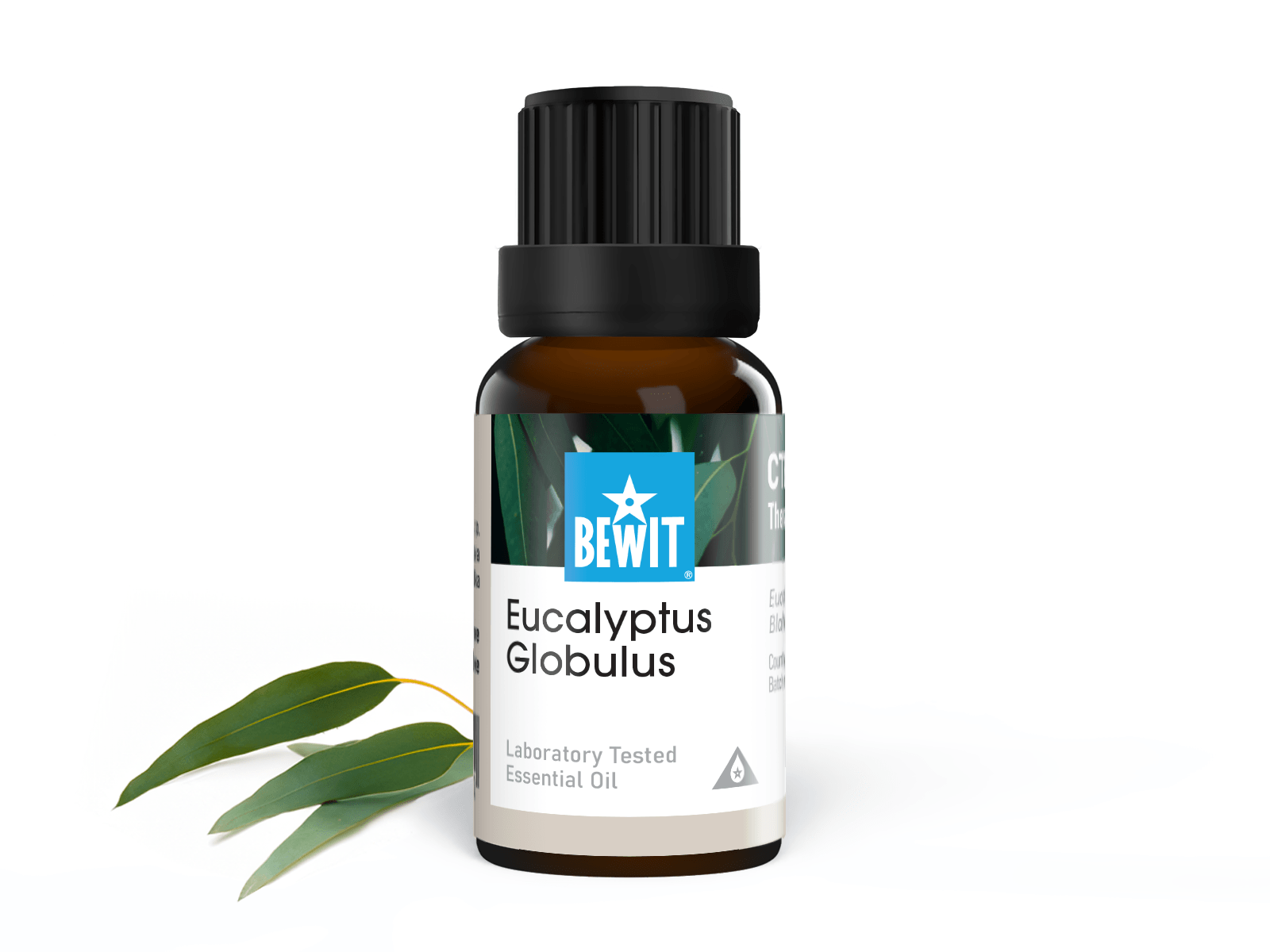
BEWIT's eucalyptus oil is steam-distilled Eucalyptus globulus tested under the CTEO® programme with GC/MS analysis for each batch. You can read how we assess suppliers and lab documentation on our trust and testing page, and browse the whole range in the essential oils catalogue.
Oils That Pair Well with Eucalyptus
Because eucalyptus is a fast-evaporating top note with a dominant character, blend it with oils that either amplify the freshness or anchor it:
- Peppermint — doubles down on the cooling effect; keep the ratio 1:1 or lower
- Lemon — lifts the medicinal edge into something brighter and friendlier
- Rosemary — a natural chemistry match (rosemary also contains 1,8-cineole)
- Pine and fir needle — builds a convincing "walk in a winter forest" accord
- Lavender — softens eucalyptus for evening use; try 1 drop eucalyptus to 3 drops lavender
- Cedarwood — a woody base note that gives short-lived eucalyptus staying power
A reliable starter formula for any diffuser: 3 parts eucalyptus, 2 parts citrus, 1 part wood. Adjust from there.
One Bottle, a Dozen Jobs
Few oils earn their shelf space like eucalyptus: shower steam, sauna, chest massage, cleaning, and gym-bag rescue from a single 15 ml bottle.
Frequently Asked Questions
What is the difference between Eucalyptus globulus and Eucalyptus radiata?
Both are cineole-rich, but globulus is stronger and sharper (typically 60–85% 1,8-cineole), while radiata is softer, slightly fruitier, and often preferred by people who find globulus too intense. For saunas, showers, and deodorizing, globulus is the classic choice.
Can I use eucalyptus oil around children?
Not near the face or airways of children under 10. High-cineole oils should never be applied to a young child's chest, neck, or pillow, or used in steam inhalation for them. Brief, well-ventilated room diffusion in a space the child can freely leave is the conservative approach for school-age children — when in doubt, choose a milder oil.
How many drops of eucalyptus should I put in my diffuser?
For a 100 ml ultrasonic diffuser, 5–7 drops in total works well — either pure eucalyptus or as part of a blend. Diffuse for 30–45 minutes, then pause. More is not better; cineole is potent, and over-diffusing can cause headaches.
Why does my eucalyptus oil smell different from a previous bottle?
Natural variation. Cineole content shifts with harvest, region, and distillation, which is precisely why batch-specific GC/MS reports matter. A dramatically flat, sweet, or solvent-like smell, however, can signal adulteration — compare against the supplier's published analysis.
Does eucalyptus oil expire?
Kept tightly closed, cool, and dark, eucalyptus oil keeps its quality for around 3 years. Oxidised oil smells duller and more acrid and is more likely to irritate skin — retire old bottles to cleaning duty rather than massage blends.
Never apply undiluted essential oils to skin. Dilute them in a carrier oil first — typically 1–2% for adults — and patch-test on a small area of skin. Safe Use Guide →
Products mentioned in this guide

Discover Premium Essential Oils
Experience the difference of CTEO-certified, European-quality essential oils.
Browse Products


Be the first to comment