
This guide contains affiliate links to BEWIT.love. If you buy through them, we may earn a commission at no extra cost to you. This never affects what we write.
In this guide
Unboxing your first essential oil diffuser is exciting — until you realise the manual answers none of the practical questions. How many drops? How much water? How long should it run? This guide walks you through everything: setup in five steps, exact drop counts for every tank size, a two-minute cleaning routine, and the mistakes that shorten a diffuser's life.

How an Ultrasonic Diffuser Works
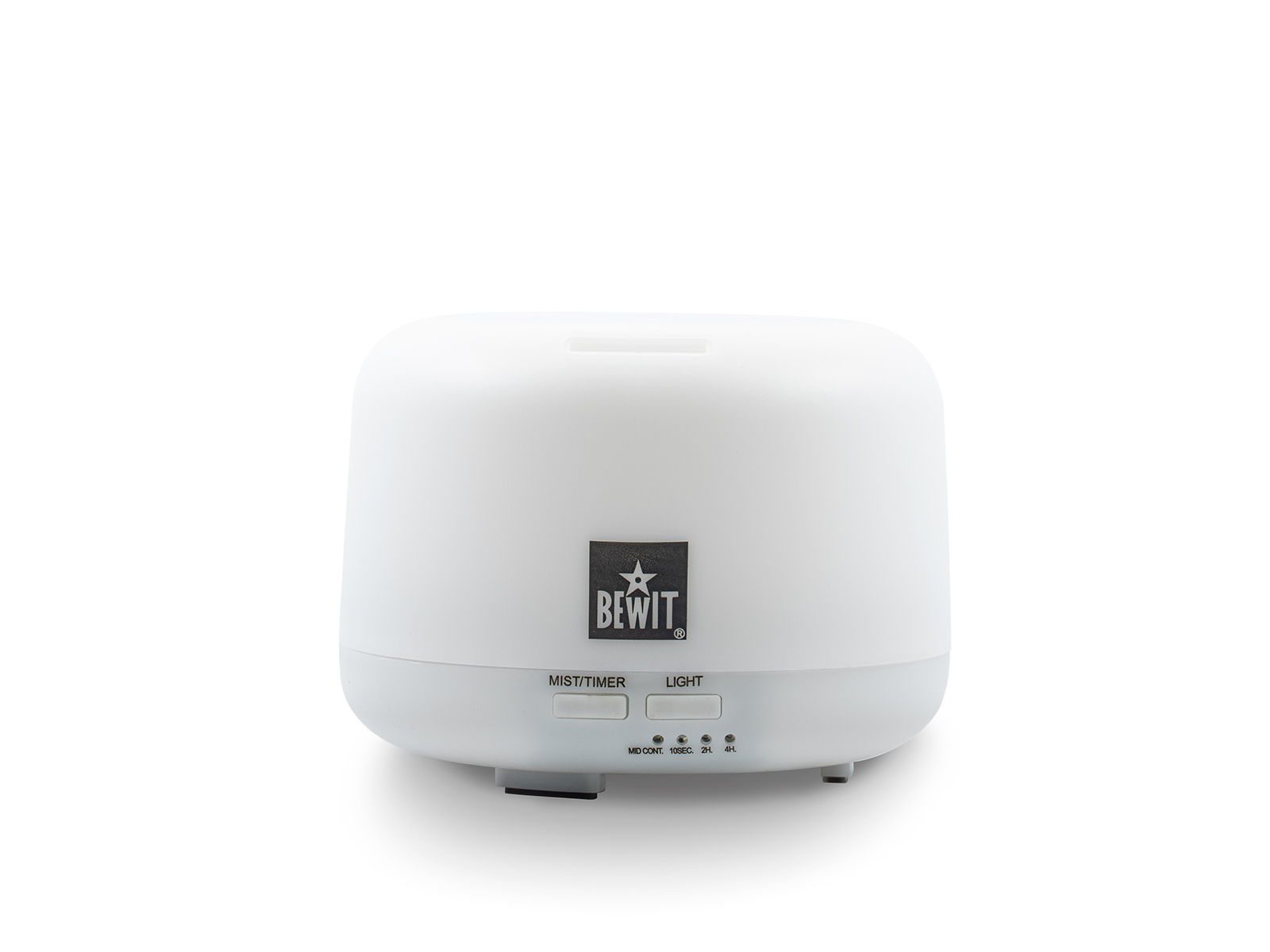
Most home diffusers — including the popular BEWIT Favorit 300 — are ultrasonic. A small ceramic disc at the bottom of the water tank vibrates at roughly 2.4 million times per second. Those vibrations break the water and essential oil into a micro-fine cool mist that disperses through the room.
Two things follow from this design. First, the mist is cool, so the delicate aroma compounds are never damaged by heat. Second, the oil is heavily diluted in water, which makes ultrasonic diffusion gentle, economical, and safe for daily use. If you are curious how ultrasonic models compare with nebulizers, heat diffusers, and evaporative sticks, see our diffuser types comparison.
Step-by-Step: Setting Up Your Diffuser
Step 1: Place It on a Stable, Elevated Surface
Choose a flat, water-resistant surface about 60–90 cm above the floor — a side table or shelf works well. Keep at least 30 cm of clearance from walls and electronics, since the mist settles as fine moisture.
Step 2: Fill With Water to the Line
Remove the cover and pour room-temperature tap water up to the marked fill line — never above it. Overfilling is the number one reason a new diffuser "doesn't mist". If your tap water is very hard, filtered water keeps the ceramic disc cleaner for longer.
Step 3: Add the Essential Oil
Add 5–10 drops for a standard 300 ml tank (see the table below for other sizes). Drop the oil directly into the water — no stirring needed, the ultrasonic plate mixes it for you. Start low; you can always add more.
Step 4: Replace the Cover and Choose a Setting
Seat the cover properly — most diffusers will not start with a misaligned lid. Select continuous or intermittent mist. If your model has a light, it works independently of the mist, so you can diffuse in the dark.
Step 5: Empty and Wipe After Use
When you are done, pour leftover water out of the side away from the air outlet and wipe the tank with a dry cloth. Thirty seconds now saves you a deep-clean later.
How Many Drops in a Diffuser? Quick Reference Table
The right dose depends on two things: tank size and room size. A useful rule of thumb is 2–3 drops per 100 ml of water for everyday use, up to 4–5 drops per 100 ml in large or well-ventilated rooms.
| Tank size | Everyday use | Stronger scent | Suits room size | Approx. run time |
|---|---|---|---|---|
| 100 ml | 3–4 drops | 5–6 drops | up to 15 m² | 3–4 hours |
| 200 ml | 4–6 drops | 7–8 drops | 15–20 m² | 5–6 hours |
| 300 ml | 6–8 drops | 9–12 drops | 20–30 m² | 7–9 hours |
| 500 ml | 8–12 drops | 13–15 drops | 30–45 m² | 10–12 hours |
Less Is More
Your nose adapts to a scent within 15–20 minutes (a phenomenon called olfactory fatigue), which tempts beginners into adding more and more oil. Resist it. If you can no longer smell the aroma, step outside the room for five minutes and come back — the scent is almost certainly still there.
How Long Should You Diffuse?
More is not better. Aromatherapy practice generally recommends diffusing in intervals of 30–60 minutes, followed by a break of similar length. There are two reasons:
- Olfactory fatigue: after 20–30 minutes you barely perceive the scent, so continuous running mostly wastes oil.
- Air saturation: in a closed room, aroma compounds accumulate; interval diffusion keeps concentrations comfortable.
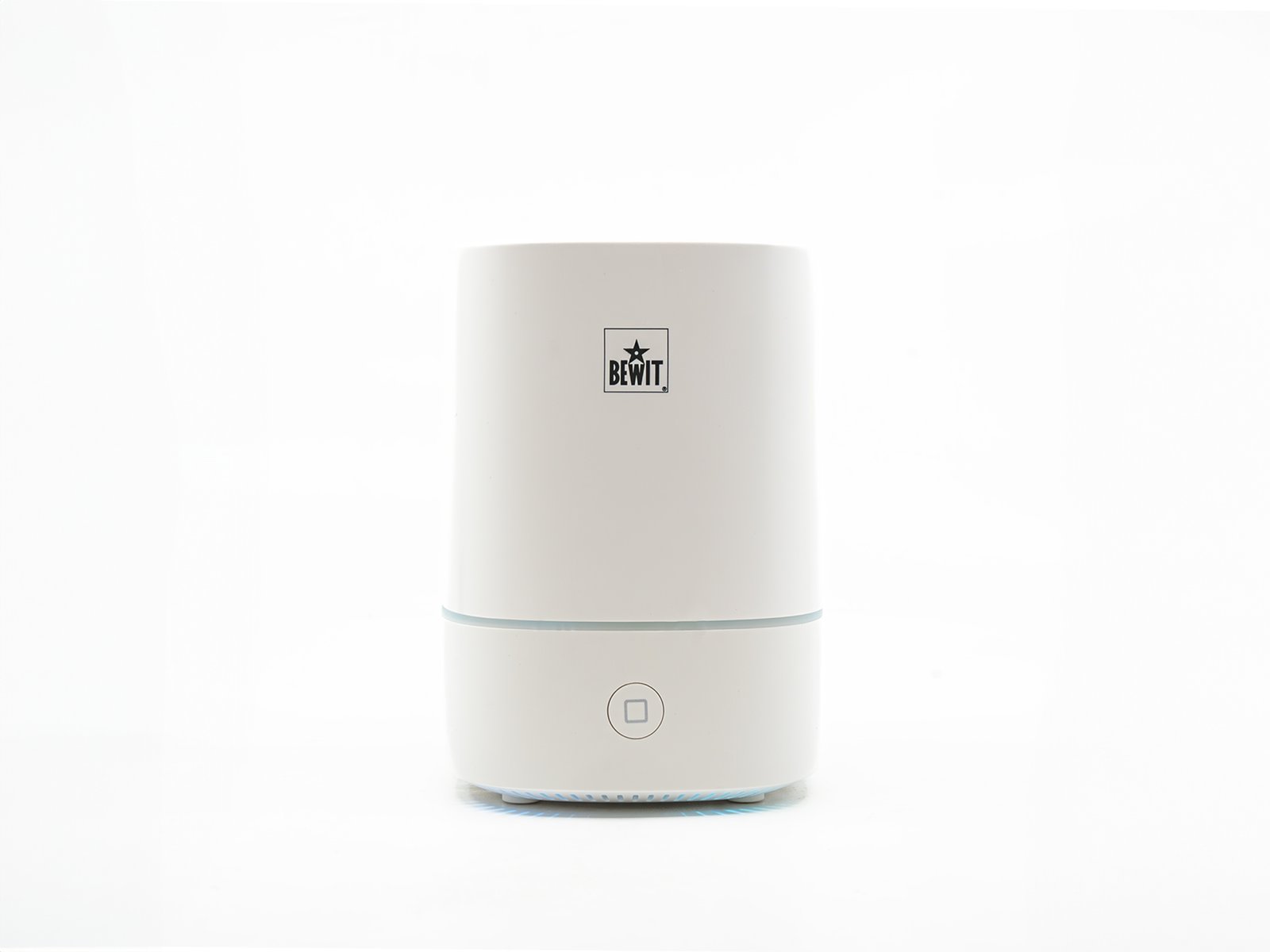
Many diffusers, such as the BEWIT Smell 300, offer a built-in intermittent mode (typically 30 seconds on, 30 seconds off), which stretches both the water and the oil across an entire evening while naturally limiting saturation. For sleep, run the diffuser 30 minutes before bedtime and let the auto shut-off do the rest — you do not need it misting all night.

Cleaning: The 2-Minute Weekly Routine
Oil residue builds up on the ultrasonic disc and gradually weakens the mist. A short weekly clean keeps output like new:
- Unplug the diffuser and empty remaining water.
- Fill halfway with warm water and add 1 teaspoon (5 ml) of white vinegar.
- Run for 3–5 minutes so the vinegar solution reaches the disc, then empty.
- Wipe the tank and gently clean the ceramic disc with a cotton swab dipped in vinegar — never scratch it with anything hard.
- Rinse with clean water, wipe dry, and leave open to air-dry.
Do a vinegar clean weekly with daily use, or at minimum whenever you switch to a very different oil — nobody wants yesterday's eucalyptus haunting tonight's sweet orange. If you are choosing oils to rotate, our favourite diffuser blend recipes are a great place to start.
7 Common Beginner Mistakes
- Overfilling past the max line — the disc cannot vibrate properly and the unit produces little or no mist.
- Using hot water — it can deform plastic parts and degrade aroma compounds; use room-temperature water.
- Too many drops — 20 drops in a 300 ml tank is not "more effective", just overwhelming and wasteful.
- Never cleaning the disc — mist output drops within 2–3 weeks of daily uncleaned use.
- Diffusing in a sealed room for hours — crack a window or door; gentle airflow actually spreads the aroma better.
- Storing it wet — standing water breeds film and odour; empty and dry after each session.
- Using fragrance oils — synthetic "fragrance" or "aroma" oils can gum up the disc and offer none of the botanical character of genuine essential oils.
Where to Place Your Diffuser
Placement changes the experience more than most people expect:
- Living room: a shelf or side table near the seating area, not directly next to the sofa — 1–2 m of distance lets the mist spread.
- Bedroom: on a dresser 2–3 m from the bed, started 30 minutes before sleep.
- Home office: on the far corner of the desk or a nearby shelf, away from your laptop and papers.
- Avoid: direct sunlight, radiators, air-conditioning drafts, and the edge of anything a child or pet could pull it from.
Pets and Small Children
Cats in particular lack the liver enzymes to process many essential oil compounds, and small children are more sensitive than adults. Always diffuse in a ventilated space pets can freely leave, keep sessions short (15–30 minutes) when they are around, and never diffuse in a closed room with an animal inside. Read our full guide on essential oils and pets and general safe use principles before diffusing around your household's most sensitive members.
Ready to Start Diffusing?
A diffuser plus two or three well-chosen oils is the simplest possible entry into aromatherapy: no dilution maths, no carrier oils, results in minutes. Start with 6–8 drops in 300 ml of water, 30–60 minute sessions, and a weekly vinegar clean — and your diffuser will serve you for years.
Frequently Asked Questions
How many drops of essential oil should I put in a diffuser?
Use 2–3 drops per 100 ml of water for everyday diffusion — that means 6–8 drops in a standard 300 ml tank. In rooms over 30 m² or for a stronger scent, go up to 4–5 drops per 100 ml. Start low and adjust after 15 minutes.
Can I use tap water in my diffuser?
Yes, room-temperature tap water is fine for most ultrasonic diffusers. If your water is very hard, filtered water reduces mineral scale on the ultrasonic disc. Avoid distilled water only if your manual says so — a few models rely on minerals for mist formation.
Is it safe to run a diffuser all night?
It is better not to. After 20–30 minutes you no longer consciously perceive the scent, and aroma compounds keep accumulating in a closed bedroom. Run the diffuser 30 minutes before bed with an auto shut-off, or use an intermittent mode if you want the aroma to last longer.
Why is my diffuser not producing mist?
Check the three usual suspects: water above the max line (pour some out), a misaligned cover (reseat it), or oil residue on the ceramic disc (do the 3–5 minute vinegar clean described above). These solve well over half of all "broken diffuser" cases.
How often should I clean my diffuser?
Wipe it dry after every use, and run the vinegar cleaning cycle once a week with daily use — or whenever you switch between strongly different oils. The whole routine takes about two minutes of hands-on time.
Some essential oils (including tea tree) are toxic to cats and dogs. Diffuse only in ventilated rooms your pet can leave, and never apply oils to animals. Safe Use Guide →
Products mentioned in this guide

Discover Premium Essential Oils
Experience the difference of CTEO-certified, European-quality essential oils.
Browse Products


Be the first to comment