This guide contains affiliate links to BEWIT.love. If you buy through them, we may earn a commission at no extra cost to you. This never affects what we write.
In this guide
- A scent can be a prompt, without becoming a promise
- What human research can actually tell us
- Choose a cue you are comfortable leaving behind
- A journal page that keeps observation separate from interpretation
- How to read what you have written
- Common mistakes: forcing a story or a result
- Safety and the boundary around difficult memories
- Questions worth asking before continuing
- An optional purchase, chosen for the scent
A scent can be a prompt, without becoming a promise
A familiar smell can be an interesting starting point for a personal memory journal. The useful question is modest: “What does this scent bring to mind for me, today?” You do not need to make yourself feel happy, retrieve a forgotten event or prove that an oil works. An ordinary association, an unclear impression and no association at all are equally acceptable entries.
Here, “scent anchor” means a personal reminder you choose to notice. It does not mean a reliable switch for a desired emotion. The journal below is an editorial suggestion for everyday adult reflection, not a validated treatment or a programme for processing trauma. A notebook and an existing, comfortable everyday scent are enough; buying an essential oil is optional.
Try separating three things on the page: what you actually smell, what you remember or imagine, and what you conclude. “Herbal scent; thought of a garden; perhaps I enjoy gardening” leaves room for uncertainty. “This oil restored my nervous system” goes far beyond what that entry can show.
What human research can actually tell us
A 2026 meta-analysis of 18 studies found selective advantages for odour cues in emotional intensity, pleasantness, feeling transported back and memory age, but no significant overall advantage for vividness or specificity. It did not test this journal or establish a trauma treatment. [1]
In a 2012 human study, 74 participants rated odours and reported spontaneous recollections. More frequently encountered smells were more likely to prompt recollection. This was an odour-rating task, not a trial of a branded oil, skin application or a therapeutic routine. [2]
The practical distinction is between noticing a response and demonstrating an effect. Your journal can describe an experience worth keeping. It cannot determine whether the scent caused a change, whether repeating it will recreate the feeling, or whether a remembered scene happened exactly as it now appears. Treat the page as a record of your present account, not independent confirmation of the past.
Choose a cue you are comfortable leaving behind
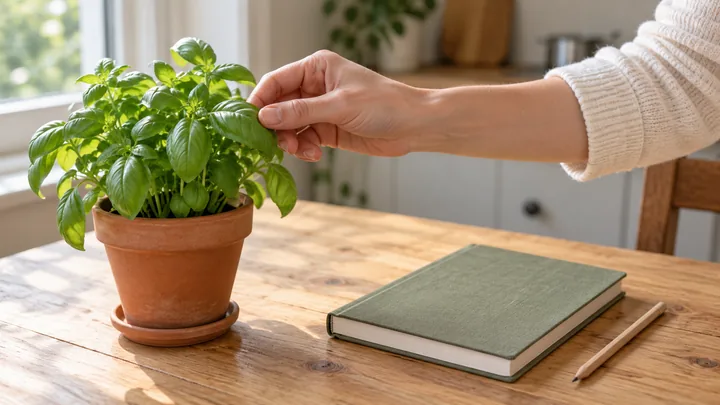
Begin with something ordinary and already acceptable in your surroundings: a familiar herb in the kitchen, for example, without changing how you normally use it. You can also start without scent, using the name of a place or an object. This gives you a way to decide whether the writing itself interests you before adding another purchase or activity.
If you already use a fragrance product comfortably, keep its normal labelled use. Do not create a stronger exposure for the sake of obtaining a more dramatic entry. Essential oil is not required on your hands, face or notebook. Leaving a page unscented also lets you read it later without deliberately repeating the exposure.
Choose according to your own preference rather than an advertised personality: a product called “confidence” cannot tell you what you ought to feel. Before using concentrated products, consult our beginner’s guide to essential oils. If a diffuser is already part of your routine, the diffuser guide covers the equipment; follow the device and product instructions rather than treating this journal as a dosing guide.
A journal page that keeps observation separate from interpretation
Use the following prompts in whatever format you prefer. They are writing aids, with no prescribed exposure time, number of sessions or target score. You can stop after a short entry and return only if you want to.
- Write the context first. Note where you are, what you were doing and how you felt before noticing the scent. Include an obvious competing influence, such as an enjoyable conversation or a rushed journey.
- Identify the cue. Record the everyday source or exact product name and its normal use. Describe the impression in your own words: dry, leafy, sweet or unfamiliar. A correct botanical answer is not the aim.
- Record the first association without searching for one. It might be a place, a person, an activity or simply a colour. Write “nothing came to mind” when that is what happened.
- Mark the type of material. Distinguish a particular remembered occasion from a general association or an imagined scene. “A garden” need not become “the day I visited my grandmother”.
- Keep feeling and certainty separate. You can feel moved while being unsure of the date, location or sequence. Leave those details open rather than completing a story for neatness.
- Describe the present ending. Did you enjoy the writing, feel unchanged, become distracted or want to stop? Include discomfort. A useful journal does not require an improvement.
- Choose what happens next. Continue another day, write without scent or leave the exercise. Do not increase the amount of oil to turn an uneventful entry into a successful one.
Keep entries private if that suits you. You do not owe a seller, a group or a social-media audience a moving story. If you later share an extract, remove other people’s identifying details and make clear that it describes your own impression.
How to read what you have written
Review the wording before deciding what the experience means. These are hypothetical examples of cautious interpretation, not reports from people who tried the exercise.
| Entry | Reasonable next step |
|---|---|
| “I thought of a holiday and enjoyed writing.” | Keep the entry; describe enjoyment without assigning a treatment effect. |
| “The smell was familiar, but no scene appeared.” | Accept the result; there is no memory target to reach. |
| “Today it felt different.” | Compare the contexts before deciding that the product changed. |
| “I wanted the smell to stop.” | Stop exposure; do not interpret discomfort as progress. |
When comparing pages, look for questions rather than a verdict. Did you enjoy the quiet writing on a day without fragrance too? Was the association already in mind before you started? Did reading an earlier entry shape what you wrote next? These questions help you avoid making a diary carry the weight of a controlled experiment.
Common mistakes: forcing a story or a result
Writing the expected answer. “Lavender should make me calm” is an expectation. Put it in a separate note if useful, then describe what you noticed. The point is to hear your own response, including indifference.
Mistaking intensity for accuracy. Do not use a powerful feeling as proof of a disputed event, or ask someone else to confirm a story solely because a smell brought it to mind. You can preserve the impression without settling its history.
Adding everything at once. New music, affirmations, movement and a new scent may make an enjoyable ritual, but the resulting page cannot isolate the contribution of the oil. If your goal is reflection, a simple setup is easier to describe honestly.
Turning repetition into an obligation. This exercise has no training target. An entry does not fail because a feeling is absent, and an expensive blend does not make an association more meaningful. Leave space for ordinary days.
Safety and the boundary around difficult memories
The BfR warns that concentrated essential oils can cause irritation, breathing problems and allergic reactions. Asthma, pregnancy, breastfeeding and allergy susceptibility need particular caution. This adult journal provides no instructions for those situations, children or animals; choose writing without fragrance instead. [3]
Do not swallow oils or apply them undiluted. Keep bottles secured away from children and pets. Stop exposure if unwell; breathing difficulty needs urgent medical help. After accidental swallowing, contact a poison centre promptly. [4]
If a scent brings distress, stop the exercise rather than repeatedly testing yourself. Seek professional support for persistent intrusive memories or distress affecting daily life. NHS guidance describes established PTSD treatments, including trauma-focused CBT and EMDR; this journal is not a substitute. [6] Any shopping choice below concerns unrelated adult fragrance enjoyment and should not delay care.
Questions worth asking before continuing
Must I use the same smell every time?
No. Keeping the cue unchanged can make your notes simpler to compare, but it is a writing choice, not a proven conditioning schedule. Record a change rather than forcing consistency.
What if I remember nothing?
Write exactly that. You can describe the scent alone, use an object as a prompt or close the notebook. There is no reason to hunt for a hidden memory.
Can I make a pleasant association on purpose?
You may choose to write about a pleasant everyday moment. Label it as a chosen reflection rather than spontaneous recall. It does not establish that the scent will reproduce the same feeling later.
An optional purchase, chosen for the scent
If you already like lavender, BEWIT Lavender is a relevant optional candidate. Its product page identifies Lavandula angustifolia and lists inhalation among its uses. These are label facts, not proof of a memory benefit. [5] Check the current local label and device compatibility before buying. If lavender is unwelcome, or scent-free writing suits you, skip the purchase. The notebook remains usable.
Sources and evidence
Evidence checked:
- Is the Proust phenomenon fact or fiction? A systematic review and meta-analysis of odor-evoked autobiographical memory Psychonomic Bulletin & Review / Springer Nature · 2026
- What properties of odor cue trigger involuntary recollection?: The effects of odor identifiability, emotional valence, and frequency of everday encounter The Japanese Journal of Cognitive Psychology / Japanese Society for Cognitive Psychology · 2012
- Essential oils: Fragrant benefits with limitations German Federal Institute for Risk Assessment (BfR) · 2026
- Essential oils: Poisonous when misused National Capital Poison Center · n.d.
- BEWIT Lavender Essential Oil BEWIT · n.d.
- PTSD (post-traumatic stress disorder) NHS · 2026
Essential oils are highly concentrated plant extracts. Follow label instructions, keep them away from children and consult a professional if you are pregnant, nursing or under medical care. Safe Use Guide →
Choose with confidence
Choose a familiar scent only if you want one
For ordinary adult fragrance enjoyment, choose by personal preference, clear labelling and compatibility with your existing device. Writing without fragrance needs no purchase. This shopping option is separate from distress or trauma care.


Be the first to comment