This guide contains affiliate links to BEWIT.love. If you buy through them, we may earn a commission at no extra cost to you. This never affects what we write.
In this guide
- Choose a smell you enjoy, without turning it into a diagnosis
- A scent map: start with a familiar reference
- What human research can tell us about preference
- A decision route from curiosity to a sensible shortlist
- Common mistakes that make choosing harder
- Safety comes before family membership
- Questions worth asking before buying
- Two concrete label examples for an adult shortlist
Choose a smell you enjoy, without turning it into a diagnosis
If you want a citrus, woody or herbal essential oil, begin with the smells you already enjoy and the setting in which you would use it. Then check the exact product and its precautions. You do not need an oil assigned to your personality, an emotional deficit or a health complaint. Choosing no fragrance is an equally valid result.
A useful shortlist answers three separate questions: what does it smell like, do I like it, and is this use suitable for me and the people nearby? A pleasing answer to the first two cannot settle the third. Keep those questions separate when a beautiful description makes a bottle tempting.
For this guide, scent families are browsing terms. They help you tell a retailer that you prefer dry wood to sweet flowers, or citrus peel to a sharp herbal note. They are not treatment categories. The aim is a purchase you can explain in ordinary sensory language, including a clear reason to walk away.
A scent map: start with a familiar reference
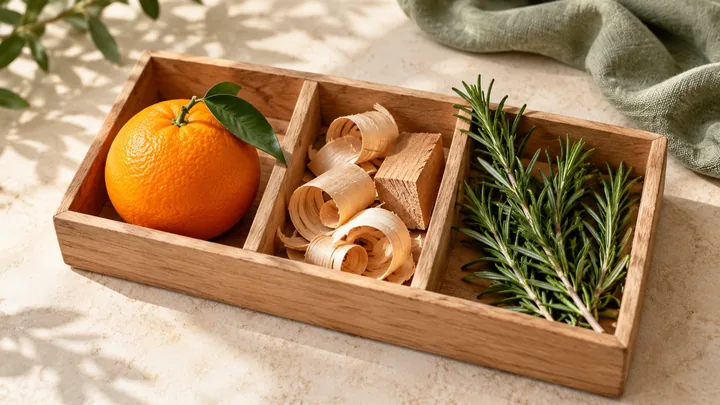
Think of a real smell rather than an advertised effect. Perhaps you enjoy peeling an orange, opening a herb cupboard or walking past cut timber. These references can help you describe a preference; they do not mean the concentrated oil will smell exactly like the original object. Treat the table as a vocabulary aid, not a formal classification or safety ranking.
| Family | Words to try | Ask yourself |
|---|---|---|
| Citrus | Peel-like, sweet, zesty | Do I want juicy sweetness or a sharper peel impression? |
| Herbal | Green, leafy, aromatic | Do I enjoy a kitchen-herb impression or find it intrusive? |
| Woody or earthy | Dry, timber-like, earthy | Do I like a dry wood impression or a deeper earthy one? |
| Floral | Petal-like, sweet, powdery | Do I want sweetness, or does it overwhelm the scent? |
| Camphoraceous, minty or spicy | Penetrating, mint-like, spice-like | Do I actually enjoy this sharpness? |
A family can be too broad to predict your reaction. You might like sweet citrus but dislike a bitter impression, or enjoy green herbs while rejecting a camphoraceous edge. Describe the particular feature rather than rejecting an entire family after one encounter. Equally, you do not have to keep exploring a family that does not interest you.
Woody does not have to mean masculine, and floral does not have to mean feminine. Those labels add expectations without helping you describe the smell. Replace them with useful contrasts: sweet or dry, delicate or pronounced, familiar or unfamiliar. You can prefer several contrasting smells without needing to identify a single signature family.
What human research can tell us about preference
A 2022 study asked 225 people from nine non-Western cultures to rank ten single-molecule odours presented in smelling pens. It found shared rankings alongside substantial individual variation. These were judgements of pleasantness, not tests of essential-oil treatment or a way to match a bottle to someone's health needs. [1]
In 2024, researchers studied 582 people across five populations using 15 odour samples. They found similarities and differences between populations; familiarity was associated with pleasantness. Different rating scales and uneven familiarity data limit interpretation. The samples were smelled, not applied as skin treatments, and the study did not establish a therapeutic scent family. [2]
A study published on 26 October 2026 examined 394 children and adults across four cultures using 11 odours in pen-like devices. Familiarity was positively associated with liking. Predominantly food-related stimuli and missing detailed dietary data limit generalisation. This observational preference study provides neither a children's oil-use protocol nor proof that repeated exposure causes benefit. [3]
The practical inference is modest: a popular scent may still be wrong for you. None of these studies tested the BEWIT bottles discussed below, established a home diffuser dose or measured recovery from illness. They concern human perception, not laboratory antimicrobial activity. A family chart cannot bridge those gaps simply by placing a benefit beside a scent description.
A decision route from curiosity to a sensible shortlist
- State the purpose in sensory terms. Write something like “I want a citrus smell for an occasional personal fragrance moment”. If the purpose is managing a symptom or treating illness, keep that question separate from shopping.
- Name an attraction and a deal-breaker. For example: “I like peel-like sweetness; I dislike a sharp, medicinal impression”. This is more useful than asking for the most powerful oil.
- Read the exact identity. Check the botanical name, whether it is a single oil or a blend, the preparation and the intended route. A familiar common name alone is not enough information for a purchase.
- Consider a retailer's designated smelling sample. Follow its instructions, avoid skin contact and do not put a bottle opening against your nose. You can decline sampling altogether if fragrance already causes problems.
- Make one comparison at a time. Use plain notes such as pleasant, neutral, unpleasant, too sweet or too sharp. Stop when you have enough information; this is choosing a smell, not a challenge to endure discomfort.
- Keep an exit option. An inconclusive sample is a reason to postpone buying. There is no requirement to purchase a whole family, a blend or a starter collection.
This is an editorial shopping aid, not a validated clinical test. It supplies no diagnostic score and no universal exposure time. For the equipment side, read the existing guide to using an essential-oil diffuser alongside the current device manual and oil label. For understanding the choice between a single identity and a mixture, see single oils versus blends.
Before paying, finish this sentence: “I am choosing this because I like its described smell, its intended use fits my plans, and I have checked the restrictions.” If you can only finish it with a promised effect, return to the label. A smaller shortlist makes it easier to notice what information is still missing.
Common mistakes that make choosing harder
Reading a descriptive word as a biological outcome. “Fresh” describes an impression; it does not demonstrate cleaner air or improved breathing. “Grounding” can express a personal association or a traditional description. As a guaranteed effect of the woody family, it is unsupported by the cited preference studies.
Assuming natural means harmless. FDA guidance notes that plant-derived fragrance ingredients can irritate skin or cause allergic reactions; certain citrus oils can be harmful on sun-exposed skin. A family name cannot establish topical safety. [4]
Using strength as a quality score. A forceful smell is not automatically the better purchase for your purpose. If you want a background fragrance, an intense profile may simply be a poor fit. Likewise, a scent you dislike is not evidence of a hidden deficiency or of your body “needing” that oil.
Letting a blend name make the choice. Ask what is in the bottle and what you like about the smell. A comforting name cannot replace that information. You can also reject the marketing story while enjoying the actual fragrance; neither response requires a medical explanation.
Safety comes before family membership
This guide is for ordinary adult fragrance choices. Do not swallow oils or sample them undiluted on skin. Skin use requires a suitable product and product-specific dilution instructions; some oils are unsuitable. Keep bottles secured away from children and pets. Stop use if a reaction occurs; breathing difficulty requires emergency help. [6]
Swiss public-health guidance advises limited, targeted room fragrance use and ventilation, with particular caution around sensitive people, including those with asthma. Address unwanted smells at their source rather than covering them. A fragrance-free room should remain available. [5]
Do not carry this adult decision aid over to children, pregnancy, breastfeeding or animals. Those situations need separate, qualified advice and the current product restrictions. Nor should shopping replace assessment of persistent symptoms. A pleasant smell is an optional consumer preference; professional care does not depend on finding a tolerable oil.
Questions worth asking before buying
Can an oil belong to more than one family?
For browsing purposes, yes: use more than one descriptor when the label supports it. The BEWIT rosemary example below is described as both herbal and camphoraceous. Treat that overlap as useful information about what to expect, rather than forcing every bottle into a single box.
Does liking a scent show it is safe for my skin?
No. Smelling pleasant and being suitable for a particular skin application are different questions. Do not turn a successful smelling sample into permission for topical use. Read the intended use and precautions separately, even when another oil with a similar name seemed acceptable.
Must I train myself to like a recommended scent?
No. Familiarity findings are not instructions to persist through discomfort. “I do not like it” is enough information to decline a fragrance. You can choose another profile, postpone the decision or keep your surroundings fragrance-free without interpreting the choice as a wellness failure.
Two concrete label examples for an adult shortlist
BEWIT Orange is labelled Citrus sinensis, cold-pressed from fruit peel, with a sweet, fresh citrus aroma and inhalation among its listed uses. Consider it if that profile appeals; the label is not evidence of a guaranteed mood effect. [7]
BEWIT Rosemary (Chemotype Cineole) is labelled Rosmarinus officinalis, steam-distilled from leaves, with an intense herbal, camphoraceous aroma and inhalation listed. It is a contrasting option only for adults for whom its restrictions permit use. Check the contraindications, including pregnancy and breastfeeding exclusions. It is not a proven concentration aid here. [8]
You do not need both bottles, and neither fills a supposed medical gap. The product links below are for comparing the current label and choosing an optional scent. Select the profile you want only after the safety questions are settled; postponing or buying nothing remains a sound decision.
Sources and evidence
Evidence checked:
- The perception of odor pleasantness is shared across cultures Current Biology · 2022
- Is the perception of odour pleasantness shared across cultures and ecological conditions? Evidence from Amazonia, East Africa, New Guinea, Malaysia and Poland Biology Letters · 2024
- Odour preferences of children and adults across four diverse cultures in Africa, Asia, Europe, and Oceania Psychonomic Bulletin & Review · 2026
- Aromatherapy U.S. Food and Drug Administration · n.d.
- Huiles essentielles Swiss Federal Office of Public Health · n.d.
- Essential oils: Poisonous when misused National Capital Poison Center · n.d.
- Orange BEWIT · n.d.
- Rosemary BEWIT · n.d.
Essential oils are highly concentrated plant extracts. Follow label instructions, keep them away from children and consult a professional if you are pregnant, nursing or under medical care. Safe Use Guide →
Choose with confidence
Compare the label, then choose your preferred profile
For optional adult fragrance use only, after checking the intended route and all restrictions. Compare the current local label before buying; neither option is a response to illness or a substitute for care. Choosing no fragrance is valid.

Be the first to comment